Nitropolis 5: How the Latest Chapter Redefines Chaos and Controlled Risk
Nitropolis 5 continues the evolution of ELK Studios’ flagship slot series, known for its volatile mechanics and layered feature systems. In this release, the developers have not simply increased intensity but introduced a more calculated structure behind the chaos. The result is a game that still delivers unpredictable sequences, yet offers clearer decision-making patterns for players who understand how the mechanics interact. This shift reflects a broader trend in 2026 game design, where high volatility is balanced with transparency and player agency.
Core Mechanics That Shape the New Risk Balance
At the centre of Nitropolis 5 is the persistent grid system, which builds upon previous versions but introduces more structured progression. Wins no longer feel purely random; instead, they are tied to evolving states of the board. Symbols, modifiers, and multipliers accumulate in ways that reward observation and timing rather than blind spins.
The introduction of advanced cluster interactions allows the grid to develop momentum. Once certain thresholds are reached, the board transitions into higher-value states, increasing both potential rewards and exposure. This creates a measurable rhythm between calm phases and explosive sequences.
Importantly, the volatility curve is more readable. While the game still delivers large swings, players can now identify when the system is approaching a high-risk, high-reward phase. This transparency reduces frustration and aligns outcomes more closely with perceived player decisions.
Dynamic Features and Their Strategic Implications
The expanded feature set in Nitropolis 5 includes persistent modifiers that carry over within sessions. These elements are not purely decorative; they actively influence probability distribution and payout potential. Understanding how these modifiers interact is essential for interpreting the game’s behaviour.
One of the key additions is adaptive multiplier scaling, which increases not only with wins but also with specific symbol interactions. This mechanic introduces a layer of conditional growth, where outcomes depend on how features combine rather than simply triggering individually.
As a result, players are encouraged to track patterns rather than rely on isolated events. The game subtly shifts from pure chance towards a hybrid model where awareness of mechanics can influence how risk is perceived and managed.
Volatility Reimagined: From Randomness to Structured Chaos
Earlier entries in the Nitropolis series were defined by extreme unpredictability, often leading to rapid swings without clear progression. In Nitropolis 5, volatility remains high, but it is distributed more evenly across gameplay phases. This creates a sense of continuity rather than abrupt spikes.
The game introduces layered volatility, where different features operate on separate risk levels. Base gameplay, modifiers, and bonus triggers each contribute independently, allowing multiple volatility streams to coexist. This design provides depth without sacrificing intensity.
Such an approach reflects a shift in player expectations. By 2026, experienced players tend to prefer systems that combine excitement with interpretability. Nitropolis 5 responds to this demand by offering controlled unpredictability rather than pure randomness.
Bonus Structures and Risk Distribution
The bonus rounds in Nitropolis 5 are no longer isolated events but extensions of the base mechanics. Instead of resetting the experience, they amplify existing systems, making previous progress relevant. This continuity strengthens engagement and reduces the feeling of disconnected gameplay phases.
Risk distribution within bonuses has also been refined. Instead of a single high-impact outcome, rewards are spread across multiple interactions. This reduces reliance on one decisive moment and creates a more sustained experience of tension and payoff.
From a design perspective, this approach aligns with modern slot development trends. Developers increasingly focus on maintaining engagement over longer sessions, rather than relying solely on rare, high-value triggers.
Player Experience in 2026: Control Without Predictability
In the current landscape, players expect more than visual intensity and high payouts. They look for systems that provide a sense of involvement without removing the element of chance. Nitropolis 5 addresses this by offering mechanics that can be understood, even if they cannot be controlled directly.
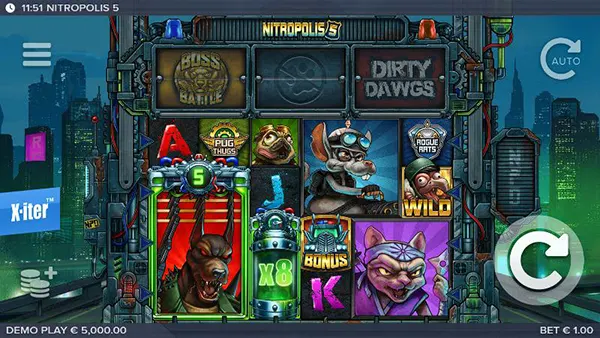
The interface and feedback systems play a significant role in this balance. Visual indicators, progression cues, and feature highlights help players interpret what is happening on the grid. This clarity transforms chaotic sequences into readable events.
At the same time, the game avoids becoming overly deterministic. Outcomes remain uncertain, preserving the core appeal of slot gameplay. The balance lies in allowing players to follow the logic of the system without guaranteeing specific results.
Long-Term Engagement and Session Design
Nitropolis 5 is structured to support extended play sessions without relying on repetitive cycles. The evolving grid and persistent features ensure that each session develops differently, even when starting conditions are similar.
This design reduces fatigue, a common issue in high-volatility games. By introducing gradual progression and layered mechanics, the game maintains interest without overwhelming the player with constant intensity.
In practical terms, this means that Nitropolis 5 is not just about chasing large wins. It is about understanding how different systems interact over time, creating a more nuanced and sustainable gameplay experience.